What Is an Aluminum PCB?
An aluminum PCB is a printed circuit board with an aluminum metal base. It is also called an aluminum core PCB, metal core PCB, or MCPCB. Its main purpose is to move heat away from components.
A normal FR4 PCB uses fiberglass as the base material. However, an aluminum PCB uses a metal base. Because aluminum transfers heat better than FR4, It helps reduce heat accumulation around high-temperature components.
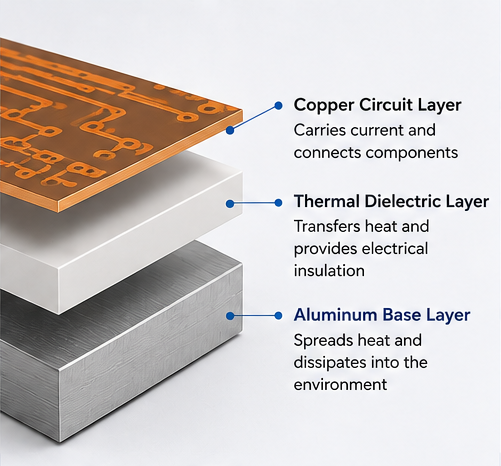
Typical aluminum-based printed circuit board has three main layers,as following:
| Layer | Main Job | Why It Matters |
|---|---|---|
| Copper Circuit Layer | Carries current and signals | Helps the circuit work |
| Thermal Dielectric Layer | Moves heat and insulates electricity | Controls heat and safety |
| Aluminum Base Layer | Spreads heat | Keeps the board cooler |
The copper layer forms the circuit. The dielectric layer moves heat downward. Then, the aluminum base spreads the heat into the housing, air, or heat sink.
Because of this structure, aluminum PCB is a strong choice for LED lights, power boards, and other heat-sensitive products.
How Does an Aluminum PCB Circuit Board Dissipate Heat?
An aluminum PCB circuit board dissipates heat through a short heat path. First, heat starts at the component. Then, it moves into the solder joint and copper layer. After that, it passes through the dielectric layer. Finally, it reaches the aluminum base.
The heat path is usually:
Component → Solder Joint → Copper Layer → Dielectric Layer → Aluminum Base → Heat Sink
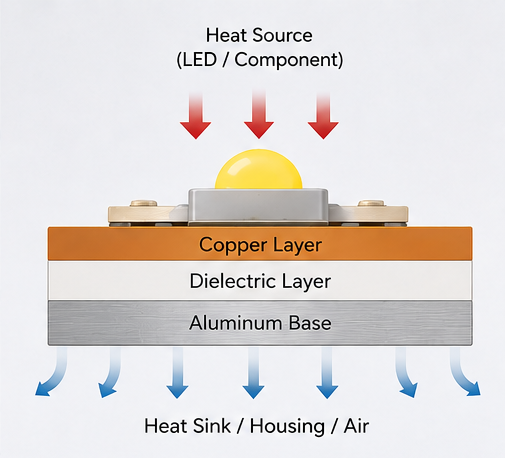
The dielectric layer is very important. It must move heat well. However, it must also keep electricity away from the aluminum base.
If this layer is poor, the board may still run hot. Therefore, the material quality matters. It is not enough to choose a board only because it has an aluminum base.
Also, the whole product design affects heat. For example, copper area, pad size, airflow, housing contact, and heat sink design all play a role. Therefore, the PCB should be reviewed together with the full product structure.
What Materials Are Used in Aluminum PCBs?
The aluminum PCB is made from copper foil, thermal dielectric material, aluminum base, solder mask, and surface finish. Each material affects heat control, electrical safety, soldering quality, and service life.
Copper Circuit Layer
The copper layer carries current. Also, it helps spread heat from component pads.
| Copper Thickness | Common Use |
|---|---|
| 1 oz | Standard LED lighting and simple circuits |
| 2 oz | Higher-current LED and power boards |
| 3 oz or above | Heavy-current power designs |
For simple LED boards, 1 oz copper is often enough. However, for automotive lamps, power boards, and industrial modules, 2 oz copper may be better.
Thicker copper can carry more current. It can also reduce heat rise. However, it may increase production cost.
Thermal Dielectric Layer
The dielectric layer sits between the copper and the aluminum base. It has two jobs. First, it moves heat. Second, it provides electrical insulation.
Important points include:
- Heat transfer
- Insulation strength
- Thickness
- Heat resistance
- Bonding strength
- Long-term stability
A thinner dielectric layer can move heat faster. However, it must still meet the voltage and safety needs of the product.
Aluminum Base Layer
The aluminum base gives the PCB strength. It also spreads heat away from hot parts.
| Aluminum Thickness | Common Use |
|---|---|
| 0.8 mm | Light LED modules |
| 1.0 mm | General lighting products |
| 1.5 mm | Common aluminum PCB design |
| 2.0 mm or above | High-power or rugged products |
For many LED boards, 1.5 mm is a common choice. However, larger lamps and industrial products may need 2.0 mm or thicker aluminum.
Solder Mask and Surface Finish
White solder mask is common for LED aluminum PCB. It reflects light better than dark solder mask. As a result, it helps improve light output.
Common surface finishes include lead-free HASL, ENIG, OSP, and immersion silver. For example, lead-free HASL is often used for standard LED boards. However, ENIG is better when the board needs a flat surface or fine-pitch parts.
What Are the Common Aluminum PCB Stackup Types?
The most common aluminum PCB is single-sided. However, double-sided and hybrid aluminum PCBs are also used. The right choice depends on heat, current, routing space, and cost.
Single-Sided Aluminum PCB
Single-sided aluminum PCB is the most popular type. The circuit and parts are on one side. The aluminum base is on the other side.It is often used in:
- LED bulbs
- Street lights
- High-bay lights
- Panel lights
- Power modules
- Simple driver boards
Also, this type is cost-effective. It gives heat a short path to the aluminum base.
Double-Sided Aluminum PCB
Double-sided aluminum PCB has circuits on both sides. It gives more space for routing. Therefore, it is useful when the circuit is more complex.
However, it is harder to produce than a single-sided board. The via structure and insulation must be controlled well.
Hybrid Aluminum PCB
Hybrid aluminum PCB combines FR4 layers with an aluminum base. It is useful when a product needs both signal routing and heat control.
For example, FR4 can handle control signals. Meanwhile, aluminum can help remove heat from the power section.
What Thermal Conductivity Should You Choose for Aluminum PCB?
The right thermal conductivity depends on the product. For many LED products, 1.0–1.5 W/m·K is enough. However, high-power products often need 2.0 W/m·K or more.
| Thermal Conductivity | Suitable Use | Simple Advice |
|---|---|---|
| 1.0 W/m·K | Low-power LED products | Good for simple lighting |
| 1.5 W/m·K | Standard LED lighting | Common choice |
| 2.0 W/m·K | Medium-power LED and power boards | Better for more heat |
| 3.0 W/m·K or higher | High-power LED, automotive, industrial boards | Good for demanding designs |
Higher thermal conductivity can move heat faster. However, it is not the only factor. Copper thickness, dielectric thickness, pad design, and heat sink contact also matter.
Therefore, do not choose material only by price. Also, do not choose the highest value without checking the real heat load.
For sealed lamps, automotive lights, medical devices, and industrial modules, it is better to leave more safety margin. As a result, the product can work more safely over time.
How Should You Design an Aluminum PCB Circuit Board Layout?
A good aluminum PCB layout should control heat, current, insulation, and mounting. The board is not only a circuit carrier. It is also part of the heat system.
Place Hot Parts Properly
High-power LEDs, MOSFETs, regulators, drivers, and power resistors should not be packed into one small area.
If hot parts are too close, hot spots may appear. As a result, some parts may age faster.
Therefore, spread hot parts when the circuit allows it. This helps the aluminum base spread heat more evenly.
Use Wider Copper for High Current
High-current traces should not be too narrow. Narrow copper creates more resistance. As a result, it creates more heat.
For high-current areas, use:
- Wider traces
- Copper pours
- Thicker copper
- Shorter current paths
- Better thermal pads
Also, copper balance is important in LED arrays. Uneven copper may affect heat flow and soldering quality.
Design Thermal Pads Well
Thermal pads help move heat from components into the PCB. For LEDs and power parts, the pad should be large enough.
Also, the pad should connect well to the copper area. As a result, the LED junction temperature can be lower.
Control Clearance and Creepage
The aluminum base is conductive. Therefore, insulation design is very important.
Check these areas:
- High-voltage spacing
- Board edge clearance
- Mounting hole isolation
- Connector spacing
- Exposed aluminum areas
- Screw contact points
This is very important for LED drivers, medical power boards, industrial power supplies, and automotive electronics.
Design Mounting Holes Carefully
Mounting holes affect both strength and safety. If screws touch the aluminum base, the design must confirm whether the base is grounded or isolated.
In many products, screws press the PCB against a heat sink. This helps heat transfer. However, the structure must not damage the insulation layer.
What Are the Advantages and Disadvantages of Aluminum PCBs?
Aluminum PCBs offer strong heat control and good strength. However, they also have some limits. For example, they cost more than basic FR4 boards. Also, they are not ideal for very dense multilayer routing.
| Item | Advantages | Limits |
|---|---|---|
| Heat Control | Good for LED and power products | Depends on dielectric quality |
| Strength | Rigid and stable | Not flexible |
| Cost | Good value for heat products | Higher than standard FR4 |
| Design | Good for simple power circuits | Harder for dense routing |
| Reliability | Reduces heat stress | Needs correct material choice |
| Rework | Stable after assembly | Rework may be harder |
The main benefit is heat control. If heat affects your product, aluminum PCB is often a good choice.
However, the board must match the real use. A high-power street light should not use the same material as a small decorative lamp. Therefore, material selection should be based on heat load, current, and working environment.
What Are Aluminum PCBs Used For?
Aluminum PCBs are used in products that need fast and stable heat transfer. They are common in LED lighting, power electronics, automotive electronics, industrial equipment, medical devices, and aerospace systems.
LED Lighting
LED lighting is one of the largest markets for aluminum PCB.Common products include:
- LED bulbs
- LED tubes
- Street lights
- High-bay lights
- Stage lights
- UV LED modules
- Panel lights
- Automotive LED lamps
In LED products, aluminum PCB helps control heat near the LED chip. As a result, it supports stable brightness and longer life.
Power Electronics
Power electronics often create high heat in small spaces. Therefore, aluminum PCB can help reduce heat build-up.
Typical products include power supplies, DC-DC converters, motor drivers, inverters, voltage regulator modules, and charging modules.
Automotive Electronics
Automotive electronics must work under heat, vibration, and long use.
Aluminum PCBs are often used in LED headlights, taillights, signal lights, interior lighting, power modules, and battery-related boards.
Industrial Equipment
Industrial products often run for long hours. Therefore, stable heat control is important.
Aluminum PCBs can be used in automation equipment, industrial LED indicators, power modules, control cabinets, motor control boards, and machine vision lighting.
Medical and Aerospace Electronics
Medical and aerospace products often need stable heat behavior and strong process control.
Aluminum PCB may be used in medical lighting, diagnostic modules, UAV electronics, aerospace lighting, and compact power boards.
In these fields, traceability, inspection records, and stable quality are also important.
Why Are Aluminum PCBs Popular in LED Lighting?
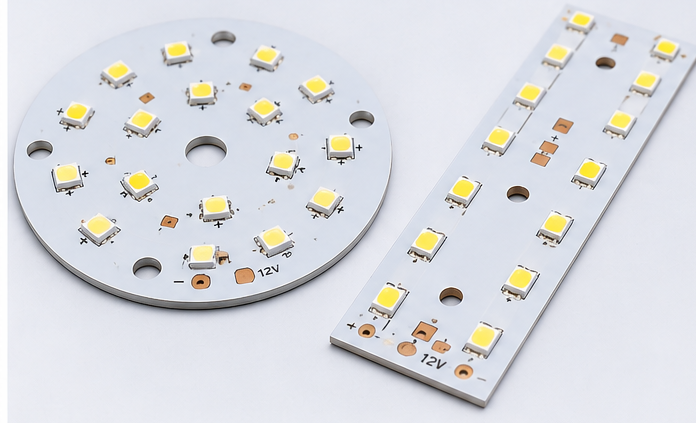
Aluminum PCBs are popular in LED lighting because LEDs create heat during use. If the heat is not removed well, brightness and life may drop.
An LED does not turn all electric energy into light. Some energy becomes heat. If this heat stays near the LED chip, the junction temperature rises.
High junction temperature may cause:
- Lower light output
- Faster lumen loss
- Color shift
- Shorter service life
- More solder joint stress
Therefore, aluminum PCB is a strong choice for LED lighting. It creates a shorter heat path from the LED package to the lamp housing or heat sink.
| Design Item | Common Choice |
|---|---|
| Board Type | Single-sided aluminum PCB |
| Board Thickness | 1.5 mm |
| Copper Thickness | 1 oz or 2 oz |
| Solder Mask | White |
| Surface Finish | Lead-free HASL or ENIG |
| Thermal Conductivity | 1.5–2.0 W/m·K |
White solder mask is common in LED aluminum PCB. It reflects light better than dark solder mask. Therefore, it supports both heat control and light output.
For high-power street lights, industrial lights, and automotive lamps, higher thermal conductivity and thicker copper may be needed.
Aluminum PCB Circuit Board vs FR4 PCB: Which Is Better?
Aluminum PCB is better for heat control. However, FR4 PCB is better for complex routing and low-heat circuits. Therefore, the better choice depends on your design goal.
| Comparison Item | Aluminum PCB Circuit Board | FR4 PCB |
|---|---|---|
| Base Material | Aluminum metal base | Fiberglass epoxy |
| Heat Control | Strong | Limited |
| Best Use | LED, power, automotive lighting | Signal, control, digital circuits |
| Circuit Complexity | Better for simple heat designs | Better for multilayer routing |
| Strength | Strong and rigid | Good for general electronics |
| Cost | Higher than basic FR4 | Lower for standard boards |
| Extra Heat Sink | Often less needed | Often needed for high power |
| Common Products | LED lighting, power modules, industrial equipment | Consumer electronics, control boards |
Choose aluminum PCB when heat is the main issue. It is suitable for LEDs, power modules, automotive lamps, and compact heat-sensitive products.
However, choose FR4 when the design needs many signal layers, fine-pitch IC routing, lower heat, and lower standard PCB cost.
In many products, both boards can be used together. For example, FR4 can handle signal control. Meanwhile, aluminum PCB can handle the LED or power section.
How to Select the Most Appropriate Aluminum PCB for Your Needs
To select the right aluminum PCB, start with heat load, current, voltage, environment, structure, and service life. Do not choose only by board thickness or price.
Check Heat Load First
Before selecting material, check:
- Component power
- Operating current
- Ambient temperature
- Enclosure design
- Heat sink contact
- Working hours
- Product life target
- Safety needs
A sealed outdoor lamp needs more heat margin than an open indoor module.
Select Thermal Conductivity
Match the thermal conductivity with the real use. For standard lighting, 1.5 W/m·K may be enough. However, compact high-power designs may need 2.0 W/m·K or higher.
Choose Copper Thickness
Copper thickness should match the current path. If the board carries higher current, use thicker copper or wider copper areas.
Otherwise, thin traces may create extra heat, even when the aluminum base is good.
Match Surface Finish
If the board uses simple LED packages, lead-free HASL may work well. However, if the board uses fine-pitch parts or needs a flatter surface, ENIG is often better.
Request DFM Review
A DFM review can find design and production risks before fabrication.
It should check trace width, spacing, mounting holes, thermal pads, solder mask openings, board edge clearance, surface finish, and assembly needs.
Finally, for high-power, automotive, medical, or industrial products, early review can reduce redesign cost and improve production stability.
EBEST Circuit: A Reliable Aluminum PCB Manufacturer
EBEST supports aluminum PCB fabrication, DFM review, component sourcing, PCBA assembly, and testing for heat-control electronic products.
For aluminum PCB projects, EBEST can review material choice, copper thickness, dielectric performance, solder mask, surface finish, layout risk, and assembly process before production.
| EBEST Circuit Capability | Customer Value |
|---|---|
| Aluminum PCB Fabrication | Supports LED, power, automotive, industrial, and heat-control designs |
| DFM Review | Helps reduce layout and production risks |
| PCB + PCBA Service | Supports fabrication, sourcing, assembly, and testing |
| Material Selection Support | Helps match heat needs and board structure |
| Prototype to Batch Production | Supports design test and production growth |
| Quality Inspection | Improves consistency and delivery confidence |
EBEST supports aluminum PCB projects for LED lighting, industrial equipment, automotive electronics, medical devices, aerospace modules, communication equipment, and power electronics.
Also, early manufacturing feedback can help customers reduce redesign work and improve delivery speed.
If you need an aluminum PCB circuit board, aluminum PCB assembly, or related PCB manufacturing support, EBEST can help from DFM review and PCB fabrication to component sourcing, assembly, and final testing. For project review or quotation support, contact sales@bestpcbs.com.
Tags: aluminum pcb, aluminum PCB circuit board, aluminum pcb manufacturer, aluminum pcb vs fr4, led pcb, pcb design
PakarPBN
A Private Blog Network (PBN) is a collection of websites that are controlled by a single individual or organization and used primarily to build backlinks to a “money site” in order to influence its ranking in search engines such as Google. The core idea behind a PBN is based on the importance of backlinks in Google’s ranking algorithm. Since Google views backlinks as signals of authority and trust, some website owners attempt to artificially create these signals through a controlled network of sites.
In a typical PBN setup, the owner acquires expired or aged domains that already have existing authority, backlinks, and history. These domains are rebuilt with new content and hosted separately, often using different IP addresses, hosting providers, themes, and ownership details to make them appear unrelated. Within the content published on these sites, links are strategically placed that point to the main website the owner wants to rank higher. By doing this, the owner attempts to pass link equity (also known as “link juice”) from the PBN sites to the target website.
The purpose of a PBN is to give the impression that the target website is naturally earning links from multiple independent sources. If done effectively, this can temporarily improve keyword rankings, increase organic visibility, and drive more traffic from search results.
Comments are closed, but trackbacks and pingbacks are open.