How Can Some Inductors Be Active and Others Passive? Inductors are traditionally viewed as passive parts that store energy in a magnetic field. But engineers often encounter the term “active inductor” in RF design, analog circuits, and integrated systems. This raises a natural question: how can inductors be passive and active?
The answer lies in understanding the physical properties of real inductors and how active circuits replicate inductive behavior using transistors. Both have important roles, but for very different reasons.
What Define Passive vs Active Components?
Passive components does not produce or amplify energy. It reacts directly to an applied electrical stimulus and cannot increase signal strength. Examples include resistors, capacitors, and classic inductors. They contribute predictable impedance but do not require an external power rail.
Active components, such as transistors, op-amps, and ICs, control current flow and can provide amplification or buffering. They require a supply voltage and can provide gain, shaping a signal beyond what the passive part offers.
Understanding this limit clarifies the discussion: real inductors made of coils are always passive. Circuits that emulate inductors using active devices can appear inductive, but are not passive. If you want to know more about active vs passive components, you can read our other posts: The main difference between active and passive components
Is an Inductor Active or Passive?
Inductors are passive components. Inductors don’t actually require an external power supply and can’t amplify a signal—they simply store energy in a magnetic field when current passes through them. Because it does not generate or control power using other energy sources, it is classified as a passive device in electronics.
However, in modern RF designs and integrated circuits, you may encounter the term active inductor, which can cause confusion. It is not a physical coil but a transistor based circuit that mimics the behavior of an inductor. Because it requires external power and uses an active device such as a MOSFET or BJT to produce inductive reactance, it is considered “active”. So although true inductors are always passive, engineers sometimes build circuits that behave like inductors using active components.
Why are inductors classified as passive components?
The behavior of physical inductors is rooted in basic electromagnetic principles. When current flows through the coil, a magnetic field is formed. When the current changes, the magnetic field changes, opposing the shift. This energy exchange occurs without an external power source.
Therefore, real inductors are passive because:
- It can store energy but does not produce energy.
- It influences current changes without external forces.
- It cannot add gain to any signal path.
- It operates solely on electromagnetic induction.
Even in complex designs such as buck converters or class D amplifiers, inductors remain simple react to replace transitions and waveforms created by active devices. All “dynamic” behavior is still passive.
How Does an Inductor Act at T 0+ and T ∞?
On T = 0⁺an inductor behaves like a short term open circuit because it resists sudden changes in current. When voltage is applied, the current through the inductor starts at zero and increases gradually, so that the inductor initially blocks current flow as if it were an open switch.
On T = ∞an inductor behaves like a short circuit because once the current reaches steady state, the inductor no longer opposes it. The stored magnetic field becomes constant, the inductor voltage drops to zero, and it effectively acts as a piece of wire with minimal resistance.
Why Do Some Inductors Appear “Active” in a Switching Power Circuit?
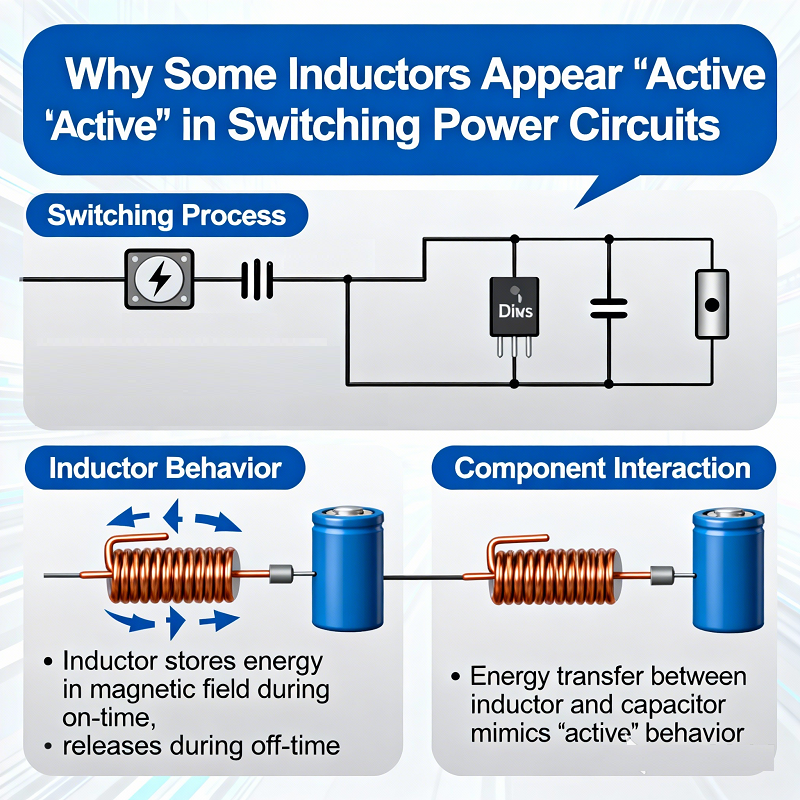
In switching circuits, inductors often behave in such a way that they appear directional and controlled—almost like active elements. For example:
- In a money converterThe inductor increases and decreases the current in sync with the MOSFET switching.
- In a boost converterThe inductor releases stored energy to increase the voltage.
- In a flyback designThe inductor (primary transformer) supplies energy during dead time.
This controlled delivery of energy appears active. However, the inductor remains passive because:
- It does not do amplification.
- It has no supply pins.
- All actions result from controlled shifts in the surroundings.
Inductors just follow physics. The “seemingly active” behavior is driven by the switching controller, not the inductor itself.
How Active Inductors Work?
Active inductors exist because integrated circuits cannot easily include large, high-quality coils. Instead, designers use transistors and feedback networks to replicate inductive reactance.
Typical active inductor approach:
- Gyrator Circuit: Create an inductive response using capacitors and active devices.
- MOSFET based inductor: Take advantage of transconductance to form coil-like current.
- Gm-C active filter: Combine tunable transconductance with capacitors for high frequency inductive behavior.
Active inductors rely on:
- Current bias
- Voltage gain
- Feedback loop
These elements allow the circuit to emulate inductance over a selected frequency range. They do not store energy magnetically; instead, they reproduce impedance profile from an inductor electrically.
How to Tell Whether an Inductor is Passive or “Like Active”?
The simplest way is to check the structure or schematic.
Passive inductor:
- Contains a coil of copper wire.
- Can use ferrite, iron, or air as the core.
- Has no power supply pins.
- Always present inductive reactance in AC.
- Storing energy in a real magnetic field.
Active inductor:
- Includes MOSFETs, BJTs, resistors, and capacitors.
- Requires biasing from VCC or VDD.
- Doesn’t behave like an inductor in DC.
- Emulates inductance only over the designed range.
- Does not produce a true magnetic field.
If it is physically wrapped around the wire, it is passive. If biasing is necessary, then active.
Why Use Active Inductors Instead of Passive Ones?
Engineers choose active inductors for reasons related to integration, size, and flexibility. The actual inductor may be too large, too expensive, or incompatible with the integrated CMOS flow. Active version offers:
- Very small footprint for RF ICs and SoCs.
- Electronically adjustable inductance for tunable filters.
- Higher effective inductance of what might happen in a small coil.
- Better integration on silicon without the need for magnets.
- Lesser parasites compared to some wound inductors.
This makes active inductors popular in:
- RF front end
- On-chip matching network
- Integrated oscillator
- Bluetooth, Wi-Fi and mmWave circuitry
- Adaptive analog system
Why Are Passive Inductors Still Needed?
Although active inductors are flexible, they cannot replace wound inductors when real magnetic energy storage or high linearity is required. Passive inductors excel in:
- Energy transfer system
- Power converter
- High current line
- EMI suppression
- Resonant circuit with high Q
- Audio crossover network
- RF circuitry that prioritizes low noise
Passive inductors also work over a wide frequency range and do not depend on bias current. They withstand much higher power levels than active circuits.
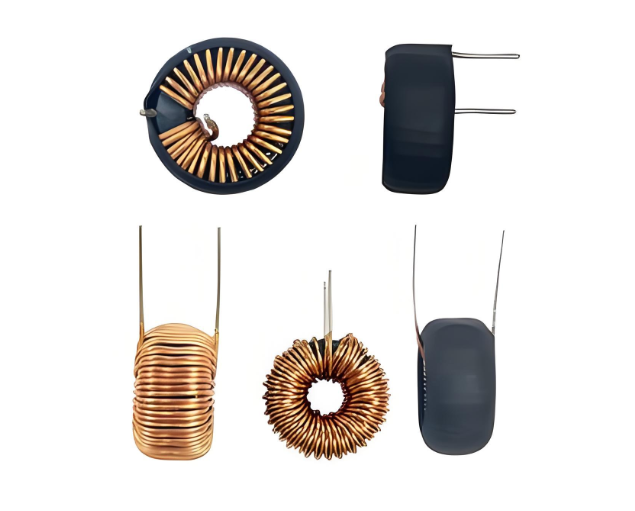
When Should You Use Passive Inductors?
Passive inductors are the right choice when applications require handling real physical energy. Use one when the design involves:
- Power conversion
- DC-DC regulation
- Motor control circuit
- High flow feeding
- RF filters require high Q
- Low noise front-end requirements
When reliability, linearity, and energy efficiency are important, real inductors are essential.
When Should You Use Active Inductors?
Active inductors become practical when design priorities shift:
- The circuit must be fully integrated on a chip.
- Board space is very limited.
- Tunability is required through voltage or current adjustments.
- Only small signal behavior is important, not high power.
- The circuit’s operating band is narrow, like RF.
If the goal is impedance generation, not energy transport, active inductors offer a compact and configurable solution.
Conclusion
Traditional inductors with wire coils are always passive. It stores energy in a magnetic field and cannot amplify the signal. Active inductors, on the other hand, are transistor-based circuits that mimic inductive behavior using gain and feedback. They are “active” because they require power and produce a controlled impedance rather than storing energy.
Both types play an important role in electronics. Understanding the differences helps engineers select the right components for RF filters, switching regulators, mixed-signal ICs, and miniaturized platforms whose performance, size, and frequency all shape the design strategy.
Tag: how some inductors can be active and some are passive
This entry was posted on Friday, December 12, 2025 at 17:39 and is filed under best PCB, best PCB, FAQ, PCB News. You can follow any responses to this entry via the RSS 2.0 feed. You can skip to the end and leave a response. Ping is currently not allowed.
News
Berita Teknologi
Berita Olahraga
Sports news
sports
Motivation
football prediction
technology
Berita Technologi
Berita Terkini
Tempat Wisata
News Flash
Football
Gaming
Game News
Gamers
Jasa Artikel
Jasa Backlink
Agen234
Agen234
Agen234
Resep
Download Film
Gaming center adalah sebuah tempat atau fasilitas yang menyediakan berbagai perangkat dan layanan untuk bermain video game, baik di PC, konsol, maupun mesin arcade. Gaming center ini bisa dikunjungi oleh siapa saja yang ingin bermain game secara individu atau bersama teman-teman. Beberapa gaming center juga sering digunakan sebagai lokasi turnamen game atau esports.
Comments are closed, but trackbacks and pingbacks are open.