Printed circuit boards (PCBs) are the foundation of modern electronics, silently connecting the parts that power every device. Understanding how PCBs work is an important part of any electronics manufacturing guide, as each component contributes to stability, performance, and functionality.
Although circuit designs vary depending on the application, most printed circuit boards have the same set of building blocks. These common PCB components work together to regulate current, regulate voltage, and ensure smooth communication between electronic systems.
In this guide, we explore ten of the most frequently used components, explaining their function and why they are important to engineers, students, and manufacturers.
Resistors
Resistors may be small, but they play an important role in almost every electronic circuit. Its main task is to control the flow of current, reduce it if necessary, and protect delicate components from damage. Resistors also help determine voltage levels in a circuit, allowing signals to reach the proper strength so other parts can interpret them correctly.
You’ll find a variety of types, including carbon film, metal oxide, and surface mount resistors. Each offers specific performance characteristics such as heat tolerance or accuracy. They are used in applications such as current limiting, transistor biasing, and signal conditioning — tasks that seem simple but are fundamental to how PCBs work.
Capacitor
Capacitors store and release electrical energy, keeping circuits stable and helping devices operate smoothly. They can act as short-term energy reserves, releasing charge when necessary to balance voltage levels. In practice, this prevents spikes and dips that can cause performance issues or even crashes.
These components also help eliminate unwanted electrical noise, which is important for devices such as audio systems and sensors that rely on signal clarity. Ceramic, electrolytic and tantalum capacitors are the most common variations, each having its own strengths in terms of capacity, response and durability. Understanding their role is an important step in understanding the basics of PCB design, as almost every circuit depends on them to maintain reliable power flow.
Inductor
Inductors store energy in a magnetic field, not as an electric charge. These characteristics make them excellent for filtering, regulating power, and regulating current flow. When used alongside capacitors and resistors, they help form regulated circuits that control frequency and filter out unwanted signals.
You’ll find inductors in power supplies, audio systems, and radio transmitters. They are essential in devices that require consistent current delivery and minimal interference. Its quiet influence on circuit performance is one reason why this component is often described as the “steady hand” in a component series.
Diode
A diode is a small but powerful component that allows current to flow in only one direction. This simple property protects the circuit from reverse voltage and prevents damage during sudden power surges. Diodes also convert alternating current (AC) to direct current (DC), making them indispensable in power conversion and control systems.
Zener diodes regulate voltage, while Schottky diodes are valued for their efficiency and fast switching capabilities. You’ll find both types throughout electronics manufacturing, from chargers and sensors to communications devices. In short, diodes keep energy flowing where it needs to go, maintaining reliability in even the most demanding applications.
Transistor
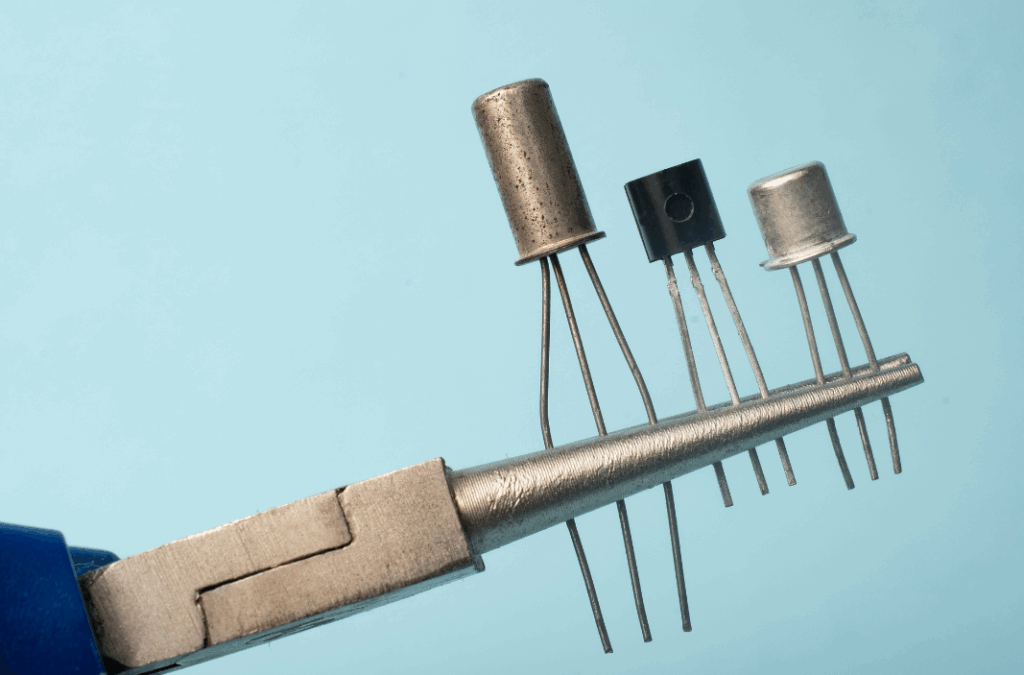
Transistors revolutionized electronics and remain at the center of almost every circuit design. Acting as switches or amplifiers, they control current and signal flow, enabling digital logic and signal processing.
There are two main types — NPN and PNP — each with different current flow characteristics. Transistors feature in microcontrollers, amplifiers, and many other systems that depend on fast and precise control. Without them, modern computing and automation would not exist. Its compact size and efficiency make it indispensable in both analog and digital circuits.
Integrated Circuits (ICs)
Integrated circuits, or ICs, combine thousands of miniature transistors, resistors, and capacitors on a single chip. This compact structure allows engineers to perform complex operations in a very small space, thereby dramatically increasing efficiency and reducing energy consumption.
ICs are used in everything from amplifiers and memory units to processors and communications modules. They form the backbone of most digital systems, translating electrical signals into meaningful instructions or data. For engineers studying how PCBs work, ICs illustrate how innovation and miniaturization have changed the design and performance of electronic devices.
Connector
Connectors bridge the gap between the PCB and the external components that interact with it. They transmit power, signals, and data, allowing devices to communicate or operate as part of a larger system.
Examples include pin headers, sockets, and edge connectors. The quality of these components can greatly impact overall reliability, especially in environments where vibration or temperature changes occur frequently. When designed properly, connectors ensure stable communications and make maintenance or upgrades easier throughout the product life cycle.
Switch
Switches control the movement of current through a circuit, allowing users to start, stop, or adjust functions manually. They can be mechanical, such as push buttons or toggle switches, or electronic, such as touch-sensitive or solid-state versions.
These components form the physical interface between the user and the device. Its feel, durability and responsiveness often shape how people perceive product quality. In other words, a switch connects human interaction with electrical control, making it much more important than its simplicity suggests.
Crystals and Oscillators
The crystal and oscillator keep the device operating in sync by producing a stable clock signal. This precise timing is important for communication between different components, especially processors, transmitters, and digital controllers.
The crystal provides natural frequency stability, while the oscillator amplifies and regulates the signal. Together, they ensure that everything in a circuit happens on time. Without it, devices will lose coordination and fail to work correctly — especially in communications systems and computing equipment where timing accuracy is non-negotiable.
Light Emitting Diodes (LED)
Light Emitting Diodes, or LEDs, are perhaps the most visible electronic components in modern design. They emit light when an electric current passes through them, serving as indicators, display elements, or lighting sources.
LEDs consume little power, last longer than traditional bulbs, and offer a wide variety of colors and brightness controls. Whether to illuminate control panels or provide feedback to users, LEDs combine practicality and efficiency. They also help engineers design user-friendly systems that communicate status or activity clearly at a glance.
These ten common PCB components form the essential framework of almost every electronic circuit. Understanding their respective roles helps engineers, designers, and students make more informed decisions regarding product performance, efficiency, and reliability.
Learning how PCBs work starts with these building blocks — each contributes something unique to the balance of the overall system. Being aware of their goals also increases collaboration between design and manufacturing teams, ensuring that each product moves smoothly from concept to production.
At Altimex, we specialize in PCB assembly and advanced electronics manufacturing. Are you perfecting PCB components layout or completely new product development, our expertise helps you realize high-quality and reliable designs. To discuss your next project, contact us Today.
The post 10 Common PCB Components appeared first on Altimex.
News
Berita
News Flash
Blog
Technology
Sports
Sport
Football
Tips
Finance
Berita Terkini
Berita Terbaru
Berita Kekinian
News
Berita Terkini
Olahraga
Pasang Internet Myrepublic
Jasa Import China
Jasa Import Door to Door
Comments are closed, but trackbacks and pingbacks are open.