The right contract PCB assembly manufacturer is the one that accepts clear responsibility for material sourcing, assembly, inspection, testing, traceability and engineering changes—not simply the company with the shortest quotation. Buyers should define those boundaries before the first build because most expensive PCBA problems appear in the gaps between the BOM, placement data, component availability, process controls and acceptance test.
This guide gives engineering and purchasing teams a practical method to compare contract assemblers. It also explains what to send with an RFQ so every supplier prices the same scope and exposes assumptions before they become schedule or quality problems.
Before shortlisting a contract PCB assembler, identify who owns every handoff from released files to accepted assemblies.
- Will the assembler buy components, accept consigned parts, or manage a mixed model?
- Who may approve alternates, and what evidence is required before a BOM substitution?
- Who checks package, polarity, rotation, stencil and assembly drawing conflicts?
- Which inspections and tests are included, and who supplies fixtures or test software?
- How are lot records, nonconformances and engineering changes linked to each build?
EBest Circuit can review the PCB and PCBA package together before quotation.
Send Gerber or ODB++, BOM, CPL/pick-and-place data, assembly drawings, quantity, approved alternates, test requirements and target delivery. The review can cover PCB fabrication, DFM questions, component sourcing, assembly, inspection and test assumptions. Project-specific capabilities and exceptions are confirmed from the actual files rather than treated as blanket promises.
What Should a Contract PCB Assembly Manufacturer Own?
A contract assembler should own the outputs explicitly assigned in the purchase order and manufacturing package. At minimum, the responsibility matrix should cover incoming material, file review, assembly process control, inspection, testing, nonconformance handling, records and shipment release. If a task is not assigned, both parties may assume the other party owns it.
| Responsibility | Manufacturer Output | Buyer Check |
|---|---|---|
| File review | Questions on BOM, CPL, drawings, polarity and process conflicts | Are questions closed before material release? |
| Material control | Approved sources, lot identity and shortage/escalation record | Can substitutions occur only after approval? |
| Assembly | Controlled stencil, placement, soldering and rework process | Does the process match the package and board mix? |
| Acceptance | Defined inspection/test results and release status | Does “tested” name the actual test? |
| Traceability | Build, material and deviation records linked to shipped units | Can a failure be traced to a lot and process event? |
Choose the Right Assembly Model: Turnkey, Partial Turnkey, or Consigned
Select the service model according to material risk and internal purchasing control. Full turnkey reduces handoffs because the manufacturer sources the parts and builds the assemblies. Consigned assembly gives the buyer tighter purchasing control but makes shortages, kitting errors and material condition shared risks. Partial turnkey sits between them and needs the clearest responsibility split.
| Model | Best Fit | Main Risk to Control |
|---|---|---|
| Full turnkey | Teams wanting one sourcing and assembly owner | Approved sources, alternates, markups and excess material |
| Partial turnkey | Buyer supplies critical parts; assembler buys standard parts | Boundary gaps, shortage ownership and schedule dependency |
| Consigned | Buyer-controlled or customer-owned component inventory | Kit accuracy, packaging, moisture exposure and attrition |
For a deeper comparison of the first option, review the full turnkey PCB assembly guide. Whichever model you select, list every buyer-supplied and manufacturer-supplied item on the quotation.
Define the NPI Handoff Before the First Build
A clean new-product-introduction handoff converts design files into a controlled build package. The manufacturer should not begin procurement or programming while critical questions remain open. Use a release gate with revision-controlled files and a named owner for each open issue.
- Freeze the quotation package. Identify the Gerber/ODB++, drill, BOM, CPL, drawings, firmware and test revision used for pricing.
- Close DFM and data conflicts. Resolve footprint, polarity, rotation, board outline, panel and soldering questions in writing.
- Approve sourcing assumptions. Confirm approved manufacturers, alternates, shortages, lifecycle risk and consigned items.
- Authorize the build. Release production only when material, process, inspection and test scope match the approved revision.
- Review first-article evidence. Compare the built assembly with the drawing, inspection plan and functional expectations before repeat production.
Make BOM Substitution Approval Explicit
No component alternate should be used merely because it fits the footprint or has a similar description. Electrical ratings, tolerance, temperature behavior, lifecycle, package geometry, terminal finish and regulatory constraints can all affect the product. The RFQ should say whether alternates are prohibited, pre-approved, or allowed only after written engineering approval.
| Substitution Check | Why It Matters | Required Evidence |
|---|---|---|
| Electrical equivalence | A nominal match may behave differently in circuit | Datasheet comparison and engineer approval |
| Package and land pattern | Body or terminal geometry changes solderability | Package drawing and footprint check |
| Lifecycle and source | A short-lived or unclear source creates repeat-build risk | Manufacturer identity and lifecycle status |
| Programming or configuration | Blank and programmed devices are not interchangeable | Programming file, checksum and label requirement |
Need a Contract Assembly Quote with Clear Responsibility?
Send the released PCB files, BOM, CPL, assembly drawings, quantity and test requirements. EBest Circuit can flag missing assumptions before sourcing or assembly begins.
Gerber/ODB++ | BOM | CPL | Drawings | Test Plan | Delivery Target
Match Package Mix to the Assembly Process
Supplier fit depends on the actual package and process mix, not a general statement that the factory offers SMT and through-hole assembly. Fine-pitch devices, bottom-terminated components, BGAs, tall connectors, press-fit parts, mixed solder requirements and heat-sensitive parts change stencil, placement, reflow, inspection and rework planning.
Ask the manufacturer to review the smallest pitch, hidden joints, thermal mass, board support needs, sensitive devices and hand-solder operations. The answer should connect each risk to a process control or inspection method. A generic equipment list does not prove that the proposed route is appropriate for your assembly.
Also ask what happens when the actual board does not behave like the standard process window. Heavy copper areas can draw heat away from nearby joints, large connectors can limit support access, and mixed component heights can complicate inspection. A credible response should identify the special operation, its acceptance check and the point at which engineering approval is required. That gives the buyer a measurable control instead of a broad capability claim.
Set Inspection and Test Responsibility in Writing
“100% tested” is incomplete unless the quotation names the inspection or test and defines the acceptance output. Visual inspection, AOI, X-ray, in-circuit testing and functional testing find different defect classes. The correct combination depends on package visibility, product risk, volume and available test access.
| Method | Useful For | Does Not Prove by Itself |
|---|---|---|
| Visual inspection | Orientation, obvious solder and workmanship checks | Hidden-joint integrity or electrical function |
| AOI | Repeatable visible SMT feature checks | Internal BGA joints or full circuit behavior |
| X-ray | Hidden joints, void patterns and internal alignment | Complete functional performance |
| Electrical/ICT | Connectivity and accessible circuit measurements | Every real operating condition |
| Functional test | Defined product behavior under a test procedure | Reliability outside the test coverage |
Require Traceability That Supports Failure Analysis
Useful traceability allows a returned assembly to be connected to its material lots, build revision, process records, inspection result and approved deviations. A serial number with no retrievable history is only a label. Before ordering, specify the traceability depth that the product and business risk require.
Ask how long records are retained, how rework is recorded, whether date/lot codes are captured for critical parts, and how nonconforming material is segregated. Also define what evidence will accompany shipments. The goal is not paperwork for its own sake; it is faster containment and more reliable root-cause analysis when a problem appears.
Traceability should remain practical. Capturing every marking on every low-risk passive may add cost without improving containment, while failing to record a critical programmed device or approved deviation can make an investigation impossible. Rank parts and operations by failure impact, then specify the records needed for those items. Ask for a sample report before the purchase order so both teams agree on what will be retrievable later.
Normalize Quotes Before Comparing Suppliers
Convert every quotation to the same scope before comparing price. One supplier may include stencil, programming, inspection, consumables and freight while another excludes them. A lower unit price can become the higher total cost after missing items, excess material, attrition and test fixtures are added.
| Quote Line | Question to Normalize | Common Gap |
|---|---|---|
| Components | Are alternates, freight, duty and excess stock included? | Lowest-price parts assumed without approval rules |
| Tooling | Are stencil, fixtures and programming setup one-time charges? | Setup appears after PO release |
| Assembly | Are SMT, THT, hand operations and rework assumptions included? | Manual operations priced later |
| Inspection/test | Which methods and reports are included? | “Inspection included” without coverage |
| Logistics | What delivery term, packing and shipping method apply? | Quotes compared under different delivery assumptions |
Check How Engineering Changes Are Controlled
Engineering changes must update the complete manufacturing package, not just the one file that triggered the revision. A BOM revision can affect purchasing, placement, programming, labels and testing. A PCB revision can invalidate stencils, fixtures or work instructions.
Ask the assembler to identify revision mismatches before release, quarantine obsolete data, and obtain approval before using changed material. For urgent changes, define who may authorize deviation, the quantity covered, and how affected units will be identified. This prevents a temporary verbal decision from becoming an uncontrolled production standard.
The buyer should provide one authoritative release location and a revision summary that states what changed. The manufacturer should return an acknowledgement listing the files loaded into production. For repeat orders, compare the new release against the last built revision and review whether existing components, stencils, fixtures, programs or labels remain valid. This small gate prevents expensive mixed-revision builds.
Plan the Prototype-to-Production Transfer
A successful prototype is evidence that one build worked; it is not yet proof that the process is ready for repeat production. Before scaling, review defects, rework, substitutions, programming, test escapes, cycle constraints and manual operations. Turn the lessons into controlled documentation.
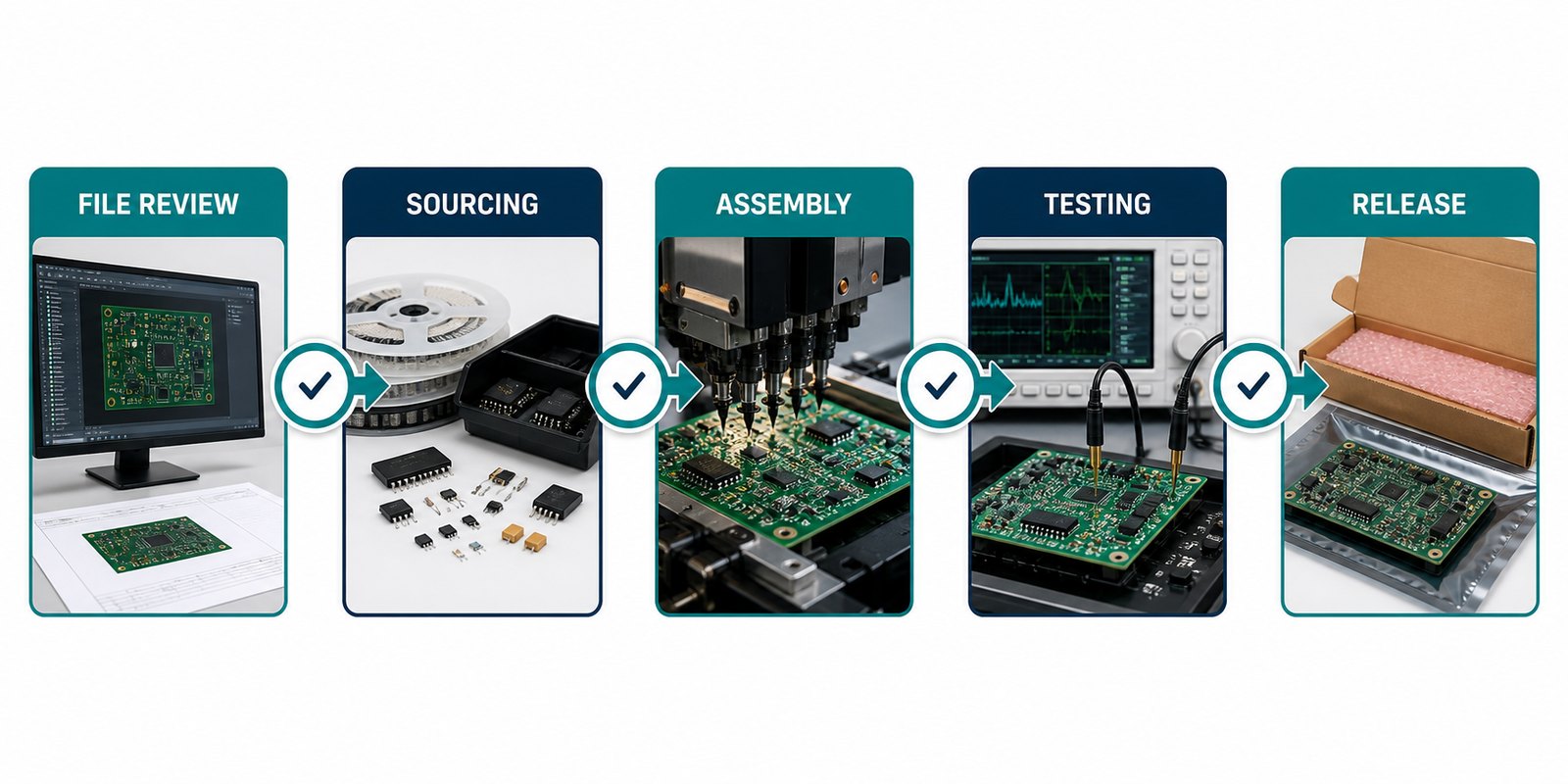
A sound transfer gate confirms that the production BOM and files match the approved build, critical material is available, fixtures are validated, acceptance criteria are stable and remaining risks have owners. If the first build required undocumented operator judgment, that judgment must be converted into a work instruction or design correction.
Audit the Manufacturer with Evidence, Not Sales Claims
Ask for project-relevant evidence and observe how the supplier handles exceptions. Capability statements matter, but the quality of file questions, quotation assumptions, sample records and corrective-action logic reveals how work is actually controlled.
- Give the supplier a controlled sample package and evaluate the questions returned.
- Ask to see anonymized examples of traceability, inspection and nonconformance records.
- Present a realistic shortage or revision scenario and ask who approves the response.
- Confirm that outsourced operations are identified and controlled.
- Check whether commercial answers match engineering answers.
Use the same evidence request for every candidate. This makes the comparison more defensible than ranking suppliers by sales presentation or website wording.
Pay attention to the questions the supplier asks. A strong manufacturer challenges ambiguous data before the order; a weak one may accept everything and surface exceptions after material is purchased. The best pre-award signal is often a concise list of project-specific questions with clear owners and due dates. That behavior shows whether engineering, purchasing and production information can move through the organization without being lost.
Prepare an RFQ Package That Produces an Actionable Quote
An actionable RFQ lets the manufacturer identify price, schedule, exclusions and risks without inventing missing requirements. At minimum, include:
- Gerber or ODB++ files, NC drill and fabrication notes.
- BOM with manufacturer part numbers, approved alternates and do-not-substitute items.
- CPL/pick-and-place data plus assembly drawings showing polarity and special handling.
- Build quantity, forecast or expected repeat volume, and target delivery.
- Turnkey, partial-turnkey or consigned material responsibility.
- Programming files, checksum, serialization and label instructions where applicable.
- Inspection, test, acceptance, reporting, packing and traceability requirements.
If you want one supplier to coordinate fabrication and assembly, the one-stop PCB manufacture and assembly guide explains the broader service model. You can also review EBest Circuit’s PCB assembly service overview before sending files.
Turn Your Assembly Package into a Comparable Quote
Send the exact files and responsibility model you want priced. EBest Circuit can review fabrication, sourcing, assembly, inspection and test assumptions together.
PCB Files | BOM/CPL | Sourcing Model | Test Scope | Traceability | Schedule
Frequently Asked Questions About Contract PCB Assembly Manufacturers
What is a PCB contract manufacturer?
A PCB contract manufacturer builds assemblies to a customer-controlled design and agreed manufacturing package. Depending on the contract, it may also source components, fabricate bare boards, program devices, inspect, test and manage shipment.
What is the difference between an EMS company and a PCB assembler?
An EMS company often offers a broader product-manufacturing scope, while a PCB assembler may focus mainly on board assembly. Actual services vary, so buyers should compare the written scope rather than the label.
Should I choose turnkey or consigned PCB assembly?
Choose turnkey when you want one sourcing and assembly owner; choose consigned when your team must control component purchasing. Partial turnkey is useful when only critical parts need buyer control.
What files do contract PCB assembly manufacturers need?
They normally need PCB fabrication data, BOM, CPL/pick-and-place data, assembly drawings, quantity and test requirements. Programming, labeling, approved alternates and packing instructions may also be required.
Who should approve component substitutions?
The buyer’s authorized engineering representative should approve substitutions unless the contract defines a pre-approved alternate list. The manufacturer should provide traceable technical and sourcing evidence before approval.
Does AOI replace functional testing?
No. AOI checks visible assembly features, while functional testing checks defined product behavior. They cover different risks and may both be needed.
How should I compare two PCBA quotations?
Normalize components, tooling, assembly operations, inspection, test, excess material, logistics and delivery terms. Compare exclusions and assumptions as carefully as unit price.
What traceability should I request?
Request enough traceability to connect shipped units with file revision, build lot, critical material, inspection, test and approved deviations. The appropriate depth depends on product and business risk.
How do I move from prototype to production?
Close prototype defects, capture rework and substitutions, validate fixtures, freeze the production package and approve a transfer gate. Do not scale undocumented prototype workarounds.
When should EBest Circuit review my project?
Send the package before supplier selection or component purchasing is locked. Early review gives more room to resolve DFM, sourcing, assembly and test assumptions without disrupting the schedule.
Final Recommendation
Choose contract PCB assembly manufacturers by responsibility clarity, evidence and repeatability. Send the same controlled RFQ package to each candidate, require written assumptions, and compare the full path from files to accepted assemblies. For an EBest Circuit review, email Gerber/ODB++, BOM, CPL, drawings, quantity, sourcing model, test scope and target delivery to sales@bestpcbs.com.
Tags: Contract Manufacturing, PCB Assembly, PCB Quote
PakarPBN
A Private Blog Network (PBN) is a collection of websites that are controlled by a single individual or organization and used primarily to build backlinks to a “money site” in order to influence its ranking in search engines such as Google. The core idea behind a PBN is based on the importance of backlinks in Google’s ranking algorithm. Since Google views backlinks as signals of authority and trust, some website owners attempt to artificially create these signals through a controlled network of sites.
In a typical PBN setup, the owner acquires expired or aged domains that already have existing authority, backlinks, and history. These domains are rebuilt with new content and hosted separately, often using different IP addresses, hosting providers, themes, and ownership details to make them appear unrelated. Within the content published on these sites, links are strategically placed that point to the main website the owner wants to rank higher. By doing this, the owner attempts to pass link equity (also known as “link juice”) from the PBN sites to the target website.
The purpose of a PBN is to give the impression that the target website is naturally earning links from multiple independent sources. If done effectively, this can temporarily improve keyword rankings, increase organic visibility, and drive more traffic from search results.
Comments are closed, but trackbacks and pingbacks are open.